
The purpose of this referencing guide is to allow you to cite your sources in a complete and homogeneous manner in accordance with the guidelines specific to Isara and Isema, based on the style of the international standard ISO-690: 2010.
General guidelines
When writing a document (file, report, dissertation), you must reference the source of all your exact quotations or paraphrases in order to:
- Justify the content of your document by allowing the reader to assess the validity of the information presented and to further his or her research by reading the sources,
- Respect the intellectual property of the authors on whom you base your work and avoid plagiarism,
- Demonstrate that your document has been thoroughly researched, which reinforces the credibility of your work.
Your bibliography contains a list of bibliographic references for all the sources used (quoted or paraphrased) in your document. It allows your reader to identify and locate your sources.
/!\ This list is presented sorted in alphabetical order of authors’ names and then in chronological order for a given author.
/!\ The bibliography is not presented by type of document.
The bibliography is found at the end of your document (last numbered page).
You will present it in a homogeneous way in the Isara – ISO-690 bibliographic style resulting from the international standard ISO-690: 2010 (in its author-date citation format).
Quotation
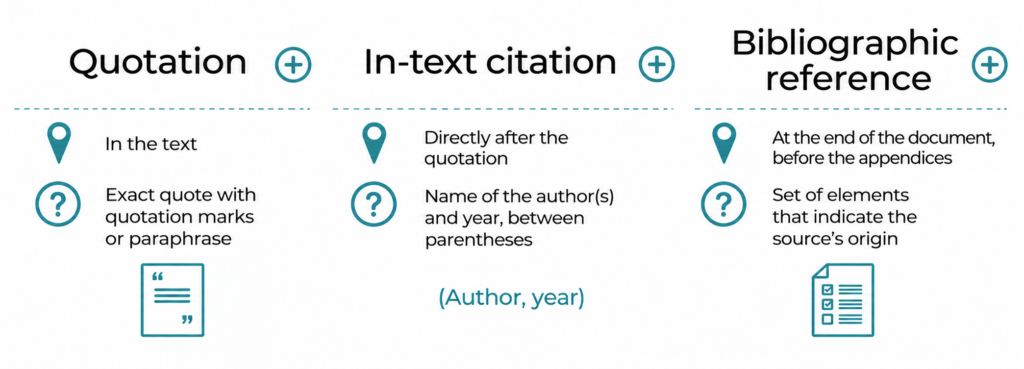
To use an excerpt from a book, article, web page or other document (that you did not write yourself) in your work, you must insert a short quotation (in quotation marks) or a paraphrase (rephrasing) in the body of the text.
In all cases, it is necessary to follow the excerpt with a citation associating the information used with the source from which it comes (see next section).
The short quote is also called exact quote. It is an exception to the French “copyright” allowing you to use an extract of a work without asking the author’s permission.
It is essential to indicate the exact text (verbatim) of the original source.
Insert the phrase(s) used between quotation marks, in the body of the text. Use […] to cut a quote.
Pay attention to the size of the quote (size of the excerpt / size of the personal essay).
Paraphrasing is the process of rephrasing an idea from another source by explaining it. It consists in retelling in your own words the idea expressed by another.
Change the order of speech and the structure of sentences, do not be satisfied with synonyms.
Make sure that you respect the meaning of the original text and that you are understandable to your reader.
Citation
When a book, article, or other document is quoted or paraphrased in the body of the text, a citation in the format (Author, Date) must always indicate the resource cited.
/!\ The citation is found just after the quoted extract in quotation marks or paraphrased.
It is the link between the quotation in the body of the text and the corresponding bibliographic reference which is found in the bibliography at the end of the document.
It will be structured in the same way whatever the type of document: book, article, thesis, web page…
The form of the citation (or citation call) depends on the bibliographic style used.
For your reports and dissertations at Isara and Isema, you must use the “author date” system.
You will not use numerical citation calls ([1], [2]…) or footnotes.
/!\ The citation call is identified, whatever the type of document, by the author’s last name and the year, indicated in brackets.
For example: (FAO, 2017).
When a paper has more than two authors, cite the 1st author followed by the phrase “et al.” :
- One author: (Lamine, 2003)
- Two authors: (Lamine, Chateauraynaud, 2007)
- Three or more authors: (Lamine et al., 2010)
- (Mundler, Valorge, 2015)
- “For we are entering an era where, in the face of human planning, nature will decide and set limits” (Rabhi, 2008).
Eventually, you can specify in the parenthesis the page or section of pages consulted in a book or article.
- According to a study conducted in several countries (FAO, 1990, pp. 12-15), the issue of agro-ecology is becoming prevalent…
When you want to indicate that you are citing an idea that is present in the same form in several different sources, include the citation calls in a single parenthesis, in alphabetical order and separated by a semicolon: (Lamine, 2003; Lecrayon, 2017).
Each source will have a separate bibliographic reference in the final bibliography.
Writing bibliographic references
In this section you will find an example of a complete bibliographic reference for various types of physical or digital resources.
A bibliographic reference is defined as the set of elements that describe a document or a resource and allow it to be clearly identified and located.
The elements that make up the bibliographic reference vary according to the type of document and the medium of the document. The way they are presented (order, formatting) depends on the bibliographic style used.
/!\ Some elements of a bibliographic reference are in all cases essential to the complete description of a resource:
- One or more names of the author(s): person or legal entity / collective (organization, company, community…)
- A date (year of publication, publication, online publication…)
- A title
- A publisher (or distributor, host…)
Other elements may appear for specific types of documents or media (see below the section I want to reference…):
- For a book: mention of edition, place of publication, ISBN, number of pages
- For a journal: title of the publication, volume numbering, ISSN
Formatting
The author’s last name is indicated in capital letters in the bibliographic reference, followed by his or her full first name if known.
The title of a book or a journal is in italics.
Several authors
When a document has more than two authors:
– in the citation, mention the 1st author followed by the mention “et al.”.
– in the bibliography, if possible, transcribe all the authors.
Several sources from the same author
To differentiate between several documents by the same author published in the same year, the dates in the citation and the bibliographic reference are followed by a distinct letter (a, b, c…).
Mention of an international standard number
If possible, indicate the ISBN for books and the DOI (digital object identifier), which is an alternative to URLs that allows for permanent identification of online articles.
Digital document
Always indicate [en ligne] in square brackets after the title. Do not forget to indicate the [date of consultation], the complete URL and/or the DOI.
Partial document
To reference only a part of a document (chapter of a book, deep web page…), remember to indicate after the title the mention “In:” followed by the title of the book or the name of the site.
Atypical document
If the resource is not a printed or digital text, specify its nature in brackets after the title of the document. Examples: [DVD], [podcast], [software], [map], [photograph], [poster], etc.
If you use Zotero, don’t forget to add it manually in the Title field.
You can write your citation calls and references manually, or use software that will allow you to automate these actions.
Zotero is a free, open source, bibliographic reference management software that allows you to automatically record, cite and reference various types of physical or digital resources.
You can find instructions and tutorials (installation and handling of the software) on the page dedicated to the Zotero user guide on this website.
I want to reference...
Bibliographic reference model
AUTHOR(S), year of publication. Title of work: subtitle. Volume and edition if applicable. Place of publication: Commercial publisher.
Examples
MUNDLER, Patrick et VALORGE, Fabien, 2015. Ateliers de transformation collectifs : Enjeux et outils pour réussir. Dijon : Educagri. ISBN 978-2-84444-980-1.
BELMER Jean. Pour un urbanisme de projet : de l’aménagement au renouvellement urbain [en ligne]. Vol.1. 3ed. Paris : Ellipses, 2011, 185 p. (Technosup, 3). [Consulté le 17 mars 2013]. Disponible à l’adresse : www.editions-ellipses.fr. ISBN 978-2-7298-6499-6.
LICHTFOUSE, Eric (éd.), 2012. Agroecology and strategies for climate change. New York : Springer. Sustainable agriculture reviews, 8. ISBN 978-94-007-1904-0.
Zotero
Books should be entered in the Book document type.
For a book consulted on the Web, indicate the mention [en ligne], the URL or DOI and the date of consultation.
The pagination, the collection and the ISBN are optional. Indicate the edition if it is not the first.
Bibliographic reference model
AUTHOR(S) of chapter, year of publication. Title of chapter. In: Title of the book. Volume and edition if applicable. Place of publication: Commercial publisher, pagination of the chapter.
Examples
MONDY, Bernard, 2014. Des premières Cuma de diversification aux ATC, vers une évolution des formes coopératives de production ? In : Ateliers de transformation collectifs. Dijon : Educagri, 297 p. ISBN 978-2-84444-980-1.
OCDE, 2005. Analyse du climat. In : Contre vents et marées : les politiques de développement face au changement climatique [en ligne]. Paris : OCDE, pp. 230-374. [Consulté le 31 octobre 2012]. Disponible à l’adresse : http://www.oecd.org/fr/.
Zotero
The book chapters are to be filled in the document type Book section.
The collection and the ISBN are optional.
Bibliographic reference model
AUTHOR(S) or ORGANIZER, year. Title of article or proceedings. In: Title of event, place, full date. Place of publication: Commercial publisher, full date of publication.
Examples
FLEURY, Philippe, CHAZOULE, Carole et PEIGNÉ, Joséphine, 2011. Agriculture biologique et agriculture de conservation : ruptures et transversalités entre deux communautés de pratiques. In : Les transversalités de l’agriculture biologique, Strasbourg, 23-24 juin 2011. Strasbourg : SFER, 2011.
CONFÉRENCE DES NATIONS UNIES SUR LE DÉVELOPPEMENT DURABLE, 2012. L’économie verte. [en ligne]. In : Conférence des Nations unies sur le développement durable, Rio, 20-22 juin 2012. [Consulté le 17 mai 2013]. Disponible à l’adresse : https://www.uncsd2012.org/.
Zotero
The type of document Conference paper includes proceedings and articles from colloquiums, conferences, symposiums or congresses.
In the case of a communication paper, proceed as for a book chapter.
Enter the title of the proceedings or the title of the symposium in the Proceedings title or Conference name field.
The pagination and ISBN are optional.
Bibliographic reference model
AUTHOR(S) or ORGANIZATION, year of publication. Dataset name (ID code if applicable) [Type]. In: Name of website where dataset can be downloaded [online]. Full date of publication or update. [Accessed dd mm yyyy]. Disponible à l’adresse : URL.
Examples
EUROSTAT, 2018. Surface agricole couverte par l’agriculture biologique (Code : sdg_02_40) [Jeu de données]. In : Eurostat - Tables, Graphs and Maps Interface (TGM) table [en ligne]. 17 août 2018. [Consulté le 3 février 2019]. Disponible à l’adresse : https://ec.europa.eu/eurostat/tgm/table.do?tab=table&init=1&language=fr&pcode=sdg_02_40&plugin=1.
OPEN FOOD FACTS, 2014. Produits alimentaires : ingrédients, nutrition, labels [Jeu de données]. In : Data.gouv.fr [en ligne]. 4 septembre 2014. [Consulté le 3 février 2019]. Disponible à l’adresse : https://www.data.gouv.fr/fr/datasets/produits-alimentaires-ingredients-nutrition-labels/#_.
Zotero
The data sets are to be filled in the Web page document type.
Indicate the author of the data and the last date of update.
Do not forget to mention the type of resource in square brackets after the title
For sites working with a code identification system, like Eurostat, specify it in the title.
Bibliographic reference model
AUTHOR(S), year of publication. Title of the article. In: Title of the Encyclopedia. Volume if relevant. Place of publication: Publisher.
Examples
DUCERF, Gérard, 2008. Scrophulariacées (ex solanées). In : L’encyclopédie des plantes bio-indicatrices. Vol.2. Briant, p. 311.
TECHNIQUES DE L’INGÉNIEUR, 2018. Biotechnologie [f]. In : Dictionnaire technique multilingue [en ligne]. Techniques de l’Ingénieur. [Consulté le 22 juin 2018]. Disponible à l’adresse : https://www.techniques-ingenieur.fr/lexique/biotechnologie-f-9790.html.
Zotero
They are to be filled in the document type Dictionary entry or Encyclopedia article.
The pagination, the collection and the ISBN are optional.
Bibliographic reference model
NAME OF CODE or AUTHOR(S) or PUBLISHING AUTHORITY, year of publication. Title or specific reference of text, paragraph or article. Website name [online]. Full date of publication or update. [Accessed dd mm yyyy]. Available at: URL.
Examples
CODE DE L’ENVIRONNEMENT, 2016. Section 1 : Conservation de sites d’intérêt géologique, d’habitats naturels, d’espèces animales ou végétales et de leurs habitats – Article L411-1. Légifrance [en ligne]. 8 août 2016. [Consulté le 16 juin 2021]. Disponible à l’adresse : https://www.legifrance.gouv.fr/codes/article_lc/LEGIARTI000033035411/.
CODE LA SANTÉ PUBLIQUE, 2007. Livre 1er : Produits pharmaceutiques. Article L5111-1 : Définitions. Légifrance [en ligne]. 27 février 2007. [Consulté le 21 mars 2018]. Disponible à l’adresse : https://www.legifrance.gouv.fr/affichCode.do?idArticle=LEGIARTI000006689867&idSectionTA=LEGISCTA000006171363&cidTexte=LEGITEXT000006072665&dateTexte=20180321.
Zotero
The document type Bill proposed by the software is restrictive to use. We suggest that you reference these documents using the Web Page type.
Indicate the complete title and the reference of the text/article or the number of the publication for the “JO” and “BO” in the Title field.
As the codes do not have an author, you can indicate their title as Author for more readability for your reader, especially in the citation call.
The date to be entered is that of the law, decree or Official Journal bulletin that published or modified the article in question. It is provided by Légifrance after “Modifié par LOI n°…”.
Bibliographic reference model
AUTHOR(S), year of publication. Patent title. Patent number. Complete date of publication of the patent.
Examples
CHUAN, Zhao, 2017. Procédé d’amélioration de l’activité catalytique. WO2017091858 (A1). 8 juin 2017.
GARCIA CASTELBLANCO, Roberto, 2018. Procédé d’obtention d’une masse radiculaire à partir de semences végétales et masse radiculaire ainsi obtenue [en ligne]. Demande de brevet européen EP3332632. 13 juin 2018. [Consulté le 28 juin 2018]. Disponible à l’adresse : https://bases-brevets.inpi.fr/
Zotero
They are to be filled in the document type Patent.
The author is the inventor, the applicant or the patent holder.
The filing date and the application number are optional.
Bibliographic reference model
AUTHOR(S), year of publication. Title of the article. Title of periodical. Complete date of publication. Volume, number, pagination. URL or DOI (if online).
Examples
VALENTINI, Jean-Luc, 2016. Réguler des auxiliaires par les oiseaux et les chiroptères. La Luciole. Décembre 2016. N°14, p.7.
WEZEL, A., BELLON, S., DORÉ, T., FRANCIS, C., VALLOD, D. et DAVID, C., 2009. Agroecology as a science, a movement and a practice. A review. Agronomy for Sustainable Development [en ligne]. Décembre 2009. Vol. 29, n° 4, p.503–515. [Consulté le 10 mars 2018]. DOI 10.1051/agro/2009004. Disponible à l’adresse : https://hal.archives-ouvertes.fr/hal-00886499. ISSN: 1773-0155.
Zotero
They are to be filled in the type of document Journal article, which includes daily newspaper, magazine and scientific journal articles.
In the case of an online article, fill in the DOI field if it is known, otherwise the URL field.
The ISSN is optional.
Bibliographic reference model
AUTHOR(S) or CREATING ORGANIZATION, year of publication. Name of the software or program + version [Type]. Name of the Web site where to download the software or program [online]. Complete date of publication or update. [Accessed on dd mm yyyy]. Available at: URL.
Example
MOZILLA FOUNDATION, 2019. Mozilla Firefox 65.0 [Logiciel]. In : Mozilla [en ligne]. 29 janvier 2019. [Consulté le 1 février 2019]. Disponible à l’adresse : https://www.mozilla.org/fr/firefox/new/.
Zotero
Software and programs are to be entered in the document type Web page or Software.
Indicate the version number if possible.
Don’t forget to mention the type of source in brackets after the title.
Bibliographic reference model
PUBLISHER OF THE STANDARD, year of publication. Title of the standard: subtitle. Reference of the standard. Place of publication: Commercial publisher.
Examples
AFNOR, 2015. Qualité du sol – Test végétal pour l’évaluation de la biodisponibilité environnementale des éléments traces pour les végétaux. NF EN ISO 16198. La Plaine Saint-Denis : Association française de normalisation.
AFNOR, 2010. Principes directeurs pour la rédaction des références bibliographiques et des citations des ressources d’information. NF ISO 690 : 2010 [en ligne]. La Plaine Saint-Denis : Association française de normalisation, 42 p. [Consulté le 19 juin 2018]. Disponible à l’adresse : https://sagaweb.afnor.org/.
Zotero
The standards are to be entered in the Book document type.
Enter the publisher or the author in the Author field and the title and reference of the standard in the Title field.
The pagination is optional.
Bibliographic reference model
AUTHOR, year of defense. Full title. Type (thesis, dissertation, report) and discipline or specialty. Place of defense : Institution of defense, number of pages.
Examples
VINCENT, Audrey, 2016. L’agriculture biologique comme réponse à la pollution de l’eau. Thèse de doctorat en Géographie, aménagement et urbanisme. Lyon : Université Lumière Lyon 2, 447p.
DUCHENE, Olivier, 2016. Relations entre céréale et légumineuse associées en agriculture biologique. Mémoire de fin d’études (MFE). Lyon : ISARA-Lyon, 80p.
JAVAHERI, Mahsa, 2009. Analyse expérimentale de la consommation de fruits et légumes [en ligne]. Thèse de doctorat en Sciences économiques. Angers : Université d’Angers, 191 p. [Consulté le 25/10/2012]. Disponible sur : http://tel.archives-ouvertes.fr/docs/00/45/93/81/PDF/these-Javaheri26oct09.pdf
Zotero
Academic writings (including Isara and Isema MFEs) must be entered in the Thesis type.
Bibliographic reference model
AUTHOR(S) or ORGANIZATION, year of publication. Title of article or page. Website name [online]. Full date of publication or update. [Accessed dd mm yyyy]. Available at: URL.
Examples
FAO, 2018. Plateforme des connaissances sur l’agroécologie. Organisation des Nations Unies pour l’alimentation et l’agriculture [en ligne]. 15 mai 2018. [Consulté le 29 mai 2018]. Disponible à l’adresse : http://www.fao.org/agroecology/fr/.
ISARA, 2012. L’ISARA-Lyon, une école d’ingénieurs au cœur de la vie. Youtube [en ligne]. 31 octobre 2012. [Consulté le 15/06/2017]. Disponible à l’adresse : https://www.youtube.com/watch?v=URsfkkYdVd8.
KHOJANDI, Kyan, 2012. C’est pas parce que tu mets une citation entre guillemets que ça te donne le droit de ne pas en citer la source. Twitter [en ligne]. 1 mai 2012. [Consulté le 31 août 2016]. Disponible à l’adresse : https://twitter.com/kyank/status/197336333314834433.
KOVALEVSKY, Olec, 2017. Mettre en œuvre le principe d’amélioration continue dans un SMQ – Ref : TIP592WEB. Techniques de l’Ingénieur [en ligne]. 28 février 2017. [Consulté le 29 mars 2021]. Disponible à l’adresse : https://www.techniques-ingenieur.fr/fiche-pratique/genie-industriel-th6/piloter-et-animer-la-qualite-dt34/mettre-en-uvre-le-principe-d-amelioration-continue-dans-un-smq-0556/.
ZOTERO, 2018. Introducing ZoteroBib: Perfect bibliographies in minutes. Zotero Blog [en ligne]. 14 mai 2018. [Consulté le 15 mai 2018]. Disponible à l’adresse : https://www.zotero.org/blog/introducing-zoterobib/.
Zotero
Articles from websites and blogs, social network pages, online videos and podcasts should be entered in the Web page type.
FAQ
– Reminder
To know what metadata is necessary for different types of documents, consult “Writing Bibliographic References.” The rules set out below apply only when there is a complete lack of an identifiable author or date on the source material. If you wish to cite a document that is missing this key information, then carefully consider its relevance, reliability, and quality. Perhaps you should instead set it aside and find a better source of information…
– Unknown Author
When the author of a document cannot be identified or is not an individual, the organization responsible for the publication is listed as the author: local government, company, organization, association, institution, scientific coordinator, etc.
The information must be consistent in both the in-text citation and the full bibliographic reference.
Examples: (FAO, 2015), (Ministry of Higher Education and Research, 1996), (Alim’Agri, 2017)
As a reminder, “Anonymous” cannot be used in the absence of an author’s name.
– Unknown date
If no date is available (after thorough verification!), use the letters “n.d.” for “no date” (sine datum), or leave the field blank.
We recommend that you exercise caution and use such information and documents sparingly—especially those obtained during training or within the host company as part of an internship or apprenticeship: course materials, activity reports, meeting minutes, internal procedures, presentations, etc.
This information or data from unpublished or undistributed documents is difficult for your graders to verify and may even be impossible for your readers to access. Therefore, these documents should not appear in the bibliography.
You should only use these unpublished documents if no published materials related to the topic at hand are available; their use must be limited.
However, if you wish to use them, you must clearly indicate in your work the context in which the information was obtained (training, presentation in a professional setting, etc.). To do so, you can explain it in the text or use a footnote, or include the document in question in an appendix.
We recommend exercising the utmost caution when using this type of information or data obtained through written correspondence or conversations, which has not been published in print or digitally and is therefore rarely accessible or verifiable by your readers (and graders).
Instead, it is advisable to clearly indicate in the body of the text—through an introductory sentence or a footnote—the identity of your source and the context in which the cited information was obtained. You may also include excerpts from verbatim transcripts of interviews in an appendix.
Images, drawings, photographs, and other illustrations must include a complete caption consisting of four elements, placed below the image: title of the work, author (required if you are not the author!), usage license (if applicable), and source (the web page where the content is located).
For tables, figures, graphs, and other data representations that you did not create yourself but have reused in your work, you must include:
- an in-text citation in the format (Author, date) after the title of the table or graph in the caption below it
- the bibliographic reference for the original document in the bibliography
If you wish to cite a text in another language, you do not need to translate it: simply place the original text in quotation marks.
You may also paraphrase it in English, taking care to ensure the quality of your translation. In either case, don’t forget to include the citation!
If the title of the resource is in its original language, you can include the bibliographic reference as is.
When researching for an assignment, dissertation or literature review, it is important to make sure that the journals you use are reliable. Predatory journals are publications that may look like legitimate academic journals but often lack proper quality controls, editorial oversight and peer review.
Look out for these warning signs:
Poor-quality website: The website contains spelling mistakes, broken links or incomplete information.
Unclear peer review: The journal does not explain how articles are reviewed before publication.
Questionable editorial board: The editors are difficult to identify or their academic affiliations cannot be verified.
False claims: The journal advertises impact factors, rankings or indexing in databases that cannot be verified.
Unusual publishing practices: The journal promises extremely quick publication or sends unsolicited emails inviting researchers to publish.
Where can I check?
You can consult Beall’s List, which identifies publishers and journals suspected of predatory publishing practices. It can be a useful starting point, but the original list was discontinued in 2017 and should not be treated as a definitive or exhaustive directory.
Top tip: If you are unsure whether a journal is trustworthy, ask your university librarian or tutor for advice. Don’t rely on a single indicator: always check the journal’s credentials and publishing practices before using its articles in your academic work.
These are abbreviations used in bibliographic styles that employ a numbering system or footnotes.
Op. cit. is the abbreviation for the Latin phrase opere citato (“in the cited work”), used to avoid repeating a bibliographic reference when the source has already been cited; one simply lists the author(s) and the relevant page. This indicates that the reference is the same as the one cited a few pages earlier or in a previous note.
Ibid. is the abbreviation of the Latin word ibidem (“in the same place”), used to indicate that this is the same reference as the one cited immediately before, with no other source cited in between. If the citations referring to the same source are not consecutive or are several pages apart, then op. cit. is used.
Example:
[1] FAURE, Guy, CHIFFOLEAU, Yuna, GOULET, Frédéric, TEMPLE, Ludovic et TOUZARD, Jean-Marc, 2018. Innovation et développement dans les systèmes agricoles et alimentaires. Versailles : Quae. Synthèses. ISBN 978-2-7592-2812-6.
[2] Ibid., p. 92.
[3] VILLEMUS, Philippe, 2018. Le leadership selon la trilogie de l’anneau. Caen : EMS Management & Société. Pratiques d’entreprises. ISBN 978-2-37687-090-6.
[4] FAURE, CHIFFOLEAU, GOULET, TEMPLE et TOUZARD, op. cit., p.128.
The number of references in the bibliography of an academic (report, paper, thesis, etc.) or scientific work depends entirely on the subject matter and how it is addressed. There is therefore no single correct answer to this question (unfortunately!), nor is there a minimum or maximum number.
The key criteria to consider are the relevance, reliability, and quality of the cited sources, as well as the presence in the body of the document of citation references that correspond to the references in the bibliography (see the section “Citation” above).